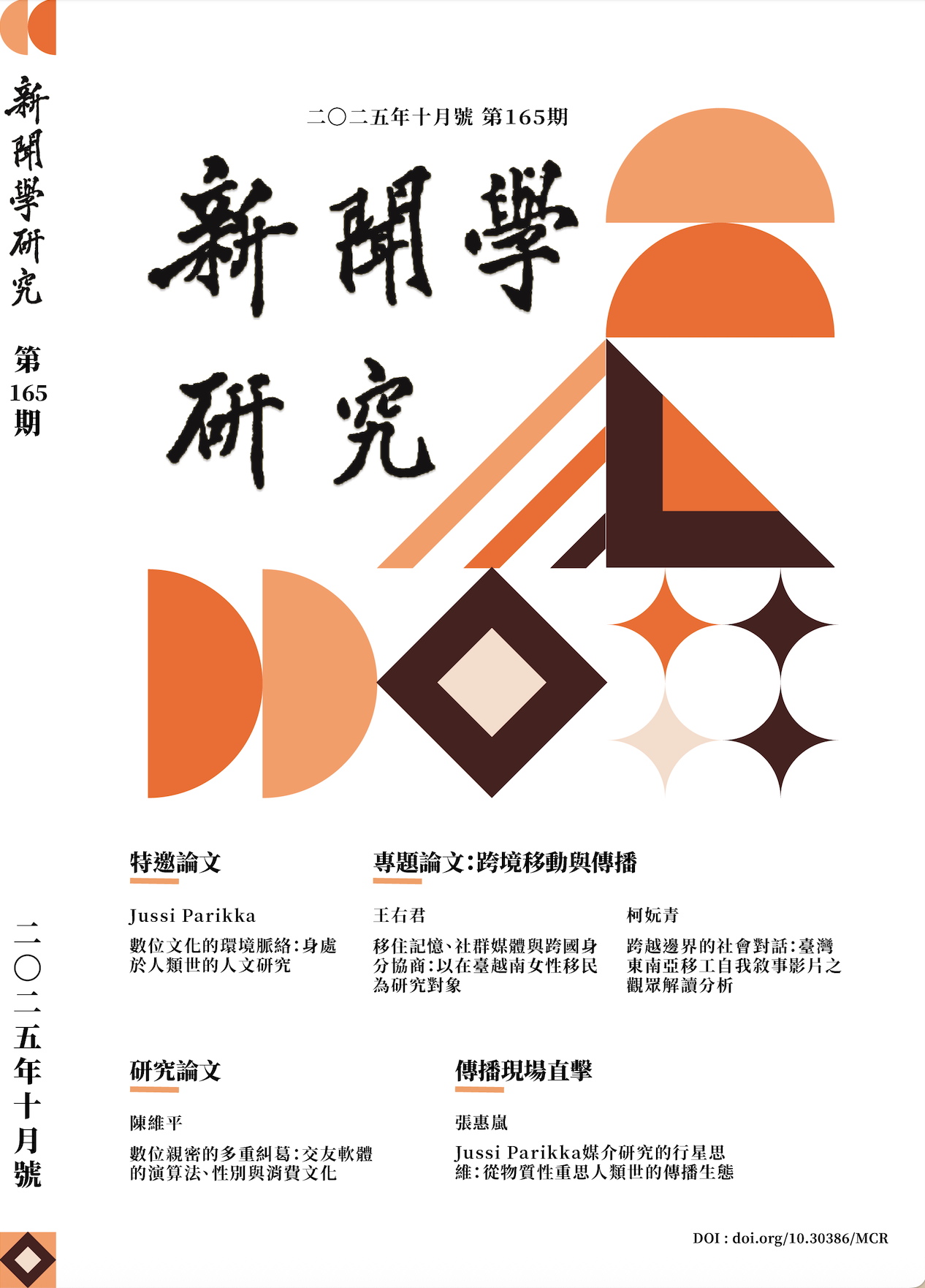

前期出版
前期出版
頁數:59﹣122
移工社群的母國文化鏈結: 以印尼移工舞團在臺運作探問
Homeland Cultural Linkages Among Migrant Workers: The Indonesian Dance Troupe in Taiwan
研究論文
作者(中)
詹婉如
作者(英)
Wan-Ru Jan
關鍵詞(中)
文化資本、社群媒體、移工、遷移、賦權
關鍵詞(英)
culture capital, social media, migrant worker, migration, empowerment,
中文摘要
本研究關注移工文化參與之主體性及能動性,側重其與母國文化鏈結,分析文化實踐對移工之意涵,希冀社會理解移工群體的多元樣貌。本文著重觀察網路如何促使移工至線下凝聚「群體」,進而於異鄉推展母國文化活動的過程及圖像。研究以在臺移工組成的印尼傳統舞團為觀察案例,於兩年田野基礎上,接觸20位舞團團員,深度訪談8位移工。
研究發現,受地理空間限制被區隔的在臺印尼移工因舞蹈興趣結合,並透過網路維持組織運作、線上自學印尼舞蹈後展演。由於移工為非專業舞者,因此簡化舞步增添異鄉文化實踐可行性,卻也發展出具獨創性的跨國移動者舞碼,並無形召喚出母國身體記憶。
此外,舞蹈是這群移工進入臺灣社會的「敲門磚」。舞團巧妙運用文化資本於異鄉開展社會對話、集體展演與社群凝聚,有助強化移工於陌生國度的歸屬與嵌入。
整體而言,在臺移工勞動處境深受客工制度影響,但這未能動搖移工創建文化社團的企圖。部分移工於框架內發展出累積參與文化活動的資本,包括帶被照顧者一同外出、與雇主分享印尼舞蹈等,以拉近勞僱關係,試圖讓接收國社會看見勞動力以外的移工「群體敘事」。
研究發現,受地理空間限制被區隔的在臺印尼移工因舞蹈興趣結合,並透過網路維持組織運作、線上自學印尼舞蹈後展演。由於移工為非專業舞者,因此簡化舞步增添異鄉文化實踐可行性,卻也發展出具獨創性的跨國移動者舞碼,並無形召喚出母國身體記憶。
此外,舞蹈是這群移工進入臺灣社會的「敲門磚」。舞團巧妙運用文化資本於異鄉開展社會對話、集體展演與社群凝聚,有助強化移工於陌生國度的歸屬與嵌入。
整體而言,在臺移工勞動處境深受客工制度影響,但這未能動搖移工創建文化社團的企圖。部分移工於框架內發展出累積參與文化活動的資本,包括帶被照顧者一同外出、與雇主分享印尼舞蹈等,以拉近勞僱關係,試圖讓接收國社會看見勞動力以外的移工「群體敘事」。
英文摘要
This research examines the underexplored process through which migrant workers in Taiwan assemble and sustain culturally-grounded collectives. Using an Indonesian dance troupe formed by migrant workers as a case, the paper presents how migrants cultivate group cohesion in a foreign setting, how they engage in the promotion of cultural activities from their country, and what these practices reveal about the meanings of cultural linkage and their broader implications for the host society.
Taiwan hosts approximately 877,000 migrant workers as of January2026, with Indonesians comprising the largest group. However, public discourse has long been shaped by reductive media framings that oscillate between victimization and problematization, reinforcing narratives that associate populations from peripheral countries with social disorder. Even under the government’s New Southbound Policy, which incorporates migrants into more affirmative storylines, mediated representations continue to reproduce narrow and stereotypical imaginaries.
Situated within an increasingly-networked media environment, this research centers on migrant workers’ communicative agency. Drawing on a case study of an Indonesian dance troupe formed by migrant workers in Taiwan, it investigates how migrants leverage digital access and mobilize cultural resources from their country of origin to develop mediated practices that reflect their lived experiences of migration. The analysis further examines how these actors work to reposition themselves as energetic producers of cultural meaning, sustaining and rearticulating transnational cultural linkages through both online and offline practices.
The study also highlights how migrant workers’ participation in cultural organizing constitutes a form of mediated cultural production that generates meanings for both migrants and the host society. Tracing how the identities of a marginalized population are constructed, negotiated, or constrained within specific representational and institutional contexts, the research demonstrates how cultural participation may broaden the discursive space for public deliberation and challenge dominant media narratives surrounding migrant communities.
This portrays an Indonesian traditional dance troupe organized by migrant workers in Taiwan as its empirical study’s entry point. Over a two-year fieldwork period, I engaged in sustained participant observation, interacted with twenty troupe members, and conducted semi-structured, in-depth interviews with eight migrant workers. These qualitative approaches are supplemented with an analysis of digital and social media materials produced by the troupe, allowing for a triangulated examination of their mediated cultural practices.
The study analytically focuses on how migrant workers mobilize information and communication technology (ICT) as communicative resources within their cultural practices. Particular attention is given to the infrastructural and interactional conditions that shape ICT use, the media forms and promotional modalities employed by the troupe, and the relational dynamics between organizers and participants.
To situate these practices within broader structures of power, the study draws on Bourdieu’s field theory to identify the forms of cultural capital articulated through performance and mediated representation. This framework assesses how migrant workers’ symbolic practices position them within the social field, and how these positions in turn shape their capacity to participate in and intervene in ongoing struggles over the representation, visibility, and cultural voice of migrant communities.
The findings indicate that digital technologies play a crucial role in connecting migrant workers who are geographically dispersed across Taiwan. Among Indonesian migrant workers, shared interest in traditional dance from the homeland serves as an initial point of cohesion, while online dissemination of activity information enables the continual recruitment of new members. This circulation of digital messages helps sustain the troupe despite the constant turnover of participants as members complete their employment contracts and return home.
Online video content further facilitates the learning of traditional Indonesian dance in the host society. Because the participants are not professionally-trained dancers, movements are often adapted or simplified to increase the feasibility of cultural practice under the constraints of migrant life. These adaptations also generate distinctive choreographic forms shaped by transnational mobility, implicitly invoking embodied memories of the homeland even as they transform traditional aesthetics.
Building on these dynamics, the troupe strategically mobilizes cultural capital to open spaces for social dialogue. Through various performance invitations, they create opportunities for audiences in the host society to encounter migrant workers beyond the dominant imagery of low-wage labor. In this process, homeland cultural forms function as an entry point, a so-called communicative door-opening device, through which migrants engage with the Taiwanese public. Such interactions foster a sense of confidence among the performers and allow them to position themselves as cultural mediators. This role not only strengthens their sense of belonging and embeddedness in an unfamiliar society, but further reframes migrant visibility through cultural expression rather than labor alone.
The structural constraints of Taiwan’s guest-worker regime at the same time mean that troupe members possess limited economic, social, and symbolic capital. Their participation in collective cultural activity relies primarily on the one form of capital they do hold, Indonesian traditional dance, as an asset valued for its cultural distinctiveness, but not recognized within the labor system.
After more than three decades of hosting foreign migrant workers, Taiwan has reached a juncture where the cultural practices of migrant communities make their agency increasingly visible. This study demonstrates how such agency becomes manifest through migrants’ cultural participation, prompting a reconsideration of how the host society might cultivate relations of social inclusion grounded in mutual recognition and subjectivity.
Initiatives organized by state institutions for immigrants and migrant workers should particularly incorporate meaningful participatory mechanisms that allow migrants to contribute to the planning and deliberation of such events. Without this, cultural activities framed as Southeast Asian risk reproducing narrow and repetitive imaginaries of migrant workers, rather than fostering more nuanced and equitable representations.
This study is limited by the scope of its empirical field, which centers on a single Indonesian migrant dance troupe. While the case offers valuable insight into the communicative practices and cultural agency of migrant workers, its specificity may not fully represent the diversity of migrant cultural formations across different nationalities or regions in Taiwan. Additionally, the research relies on qualitative methods and extended field engagement, which, although providing rich contextual understanding, do not capture the broader structural patterns that may shape migrant cultural participation at a societal level. Future research may deepen the comparative dimension by examining multiple migrant cultural groups, including those that differ in organizational forms, cultural repertoires, or levels of digital engagement.
This paper highlights the need to address issues of continuity and succession within migrant cultural organizations. The Indonesian dance troupe examined has existed for thirteen years, yet Taiwan’s current guest worker system restricts the long-term retention of members. Future research should consider how institutional constraints on migrant workers’ ability to remain in Taiwan create structural gaps in transmission, and how such gaps shape the sustainability of migrant-led cultural practices over time.
Taiwan hosts approximately 877,000 migrant workers as of January2026, with Indonesians comprising the largest group. However, public discourse has long been shaped by reductive media framings that oscillate between victimization and problematization, reinforcing narratives that associate populations from peripheral countries with social disorder. Even under the government’s New Southbound Policy, which incorporates migrants into more affirmative storylines, mediated representations continue to reproduce narrow and stereotypical imaginaries.
Situated within an increasingly-networked media environment, this research centers on migrant workers’ communicative agency. Drawing on a case study of an Indonesian dance troupe formed by migrant workers in Taiwan, it investigates how migrants leverage digital access and mobilize cultural resources from their country of origin to develop mediated practices that reflect their lived experiences of migration. The analysis further examines how these actors work to reposition themselves as energetic producers of cultural meaning, sustaining and rearticulating transnational cultural linkages through both online and offline practices.
The study also highlights how migrant workers’ participation in cultural organizing constitutes a form of mediated cultural production that generates meanings for both migrants and the host society. Tracing how the identities of a marginalized population are constructed, negotiated, or constrained within specific representational and institutional contexts, the research demonstrates how cultural participation may broaden the discursive space for public deliberation and challenge dominant media narratives surrounding migrant communities.
This portrays an Indonesian traditional dance troupe organized by migrant workers in Taiwan as its empirical study’s entry point. Over a two-year fieldwork period, I engaged in sustained participant observation, interacted with twenty troupe members, and conducted semi-structured, in-depth interviews with eight migrant workers. These qualitative approaches are supplemented with an analysis of digital and social media materials produced by the troupe, allowing for a triangulated examination of their mediated cultural practices.
The study analytically focuses on how migrant workers mobilize information and communication technology (ICT) as communicative resources within their cultural practices. Particular attention is given to the infrastructural and interactional conditions that shape ICT use, the media forms and promotional modalities employed by the troupe, and the relational dynamics between organizers and participants.
To situate these practices within broader structures of power, the study draws on Bourdieu’s field theory to identify the forms of cultural capital articulated through performance and mediated representation. This framework assesses how migrant workers’ symbolic practices position them within the social field, and how these positions in turn shape their capacity to participate in and intervene in ongoing struggles over the representation, visibility, and cultural voice of migrant communities.
The findings indicate that digital technologies play a crucial role in connecting migrant workers who are geographically dispersed across Taiwan. Among Indonesian migrant workers, shared interest in traditional dance from the homeland serves as an initial point of cohesion, while online dissemination of activity information enables the continual recruitment of new members. This circulation of digital messages helps sustain the troupe despite the constant turnover of participants as members complete their employment contracts and return home.
Online video content further facilitates the learning of traditional Indonesian dance in the host society. Because the participants are not professionally-trained dancers, movements are often adapted or simplified to increase the feasibility of cultural practice under the constraints of migrant life. These adaptations also generate distinctive choreographic forms shaped by transnational mobility, implicitly invoking embodied memories of the homeland even as they transform traditional aesthetics.
Building on these dynamics, the troupe strategically mobilizes cultural capital to open spaces for social dialogue. Through various performance invitations, they create opportunities for audiences in the host society to encounter migrant workers beyond the dominant imagery of low-wage labor. In this process, homeland cultural forms function as an entry point, a so-called communicative door-opening device, through which migrants engage with the Taiwanese public. Such interactions foster a sense of confidence among the performers and allow them to position themselves as cultural mediators. This role not only strengthens their sense of belonging and embeddedness in an unfamiliar society, but further reframes migrant visibility through cultural expression rather than labor alone.
The structural constraints of Taiwan’s guest-worker regime at the same time mean that troupe members possess limited economic, social, and symbolic capital. Their participation in collective cultural activity relies primarily on the one form of capital they do hold, Indonesian traditional dance, as an asset valued for its cultural distinctiveness, but not recognized within the labor system.
After more than three decades of hosting foreign migrant workers, Taiwan has reached a juncture where the cultural practices of migrant communities make their agency increasingly visible. This study demonstrates how such agency becomes manifest through migrants’ cultural participation, prompting a reconsideration of how the host society might cultivate relations of social inclusion grounded in mutual recognition and subjectivity.
Initiatives organized by state institutions for immigrants and migrant workers should particularly incorporate meaningful participatory mechanisms that allow migrants to contribute to the planning and deliberation of such events. Without this, cultural activities framed as Southeast Asian risk reproducing narrow and repetitive imaginaries of migrant workers, rather than fostering more nuanced and equitable representations.
This study is limited by the scope of its empirical field, which centers on a single Indonesian migrant dance troupe. While the case offers valuable insight into the communicative practices and cultural agency of migrant workers, its specificity may not fully represent the diversity of migrant cultural formations across different nationalities or regions in Taiwan. Additionally, the research relies on qualitative methods and extended field engagement, which, although providing rich contextual understanding, do not capture the broader structural patterns that may shape migrant cultural participation at a societal level. Future research may deepen the comparative dimension by examining multiple migrant cultural groups, including those that differ in organizational forms, cultural repertoires, or levels of digital engagement.
This paper highlights the need to address issues of continuity and succession within migrant cultural organizations. The Indonesian dance troupe examined has existed for thirteen years, yet Taiwan’s current guest worker system restricts the long-term retention of members. Future research should consider how institutional constraints on migrant workers’ ability to remain in Taiwan create structural gaps in transmission, and how such gaps shape the sustainability of migrant-led cultural practices over time.
1586次下載
2026/ 春
No.167