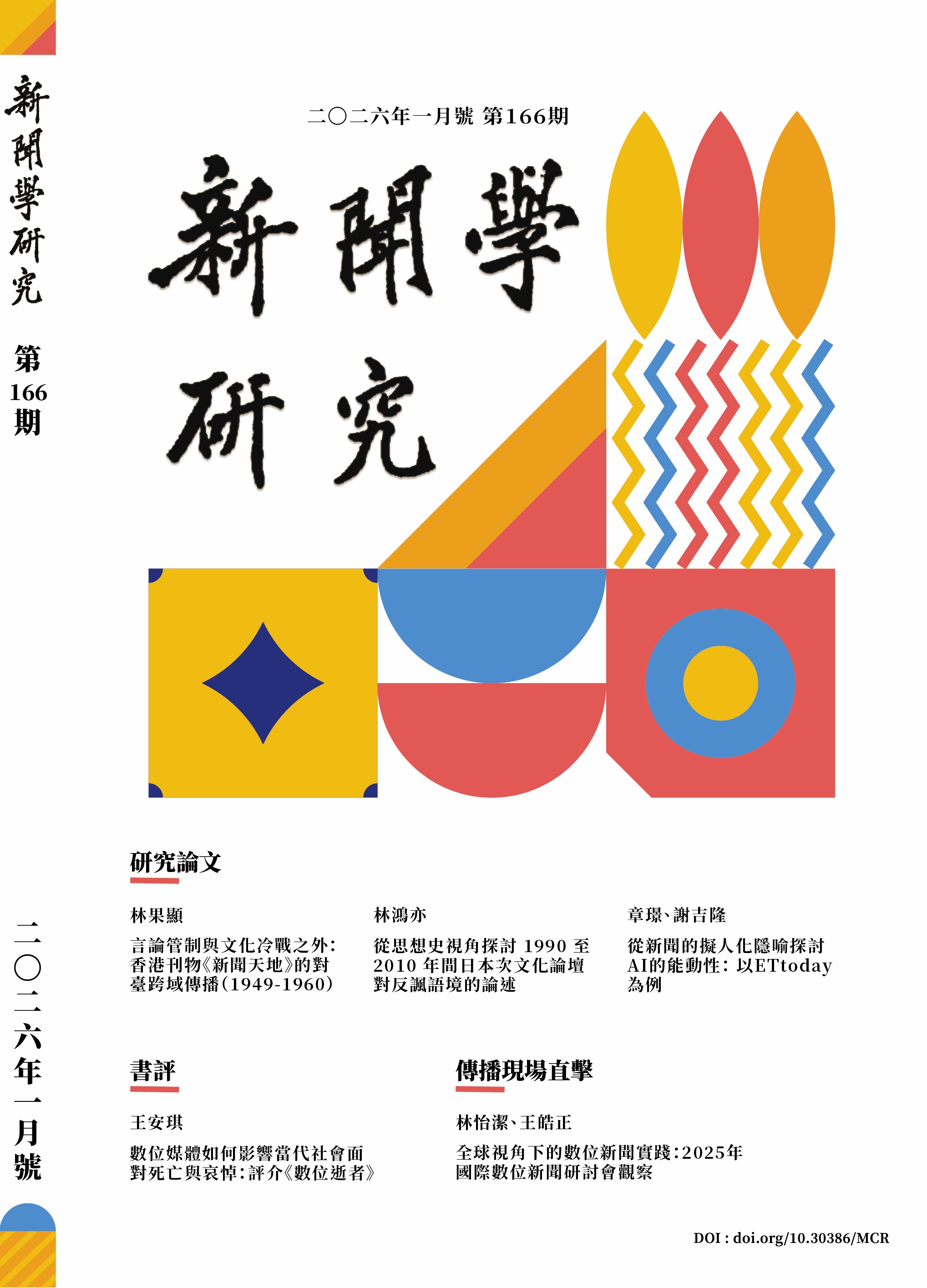

前期出版
前期出版
頁數:41﹣92
從思想史視角探討1990至2010年間日本次文化論壇對反諷語境的論述
Examining Discourses Concerning Irony in Japanese Subcultural Forums between the 1990s and 2000s from the Intellectual History
研究論文
作者(中)
林鴻亦
作者(英)
Hung-Yi Lin
關鍵詞(中)
反諷、自由主義、次文化、後設認知、御宅族
關鍵詞(英)
irony, liberalism, subculture, meta-cognition, otaku
中文摘要
本研究梳理1990到2010年間日本次文化論壇中幾位論客對反諷語境的討論,盼能為該時期的日本思想史提出反諷作為時代關鍵字的可能性。冷戰結束後,在自由主義作為意識形態主流的社會情境下,大型敘事不僅凋零,其價值、主張之間不必然對立的相對主義讓人們不知何去何從。另一方面,以生產小型敘事的次文化文本則在強勁的文化消費力道下,於日本社會發揮巨大的影響力,並逐漸成為人們理解世界、反思現實的參考。
但次文化作為消費的對象,也著實讓虛構成為理解或回應現實的素材。所以,過去的相對主義所呈現的反諷語境,也從容忍他者的價值相對主義,逐漸轉變為虛構與現實之間得以並存的虛實相對主義。而網路社群對話時代的來臨,不僅讓御宅族們能感動地沉浸在反諷語境,網路對話的積累更是形成以資料庫為基礎的反諷遊戲。這種藉由反諷而遠離反諷本質中具有的反省,不僅讓反諷劣化為嘲諷,也造就全民御宅族化、處處同溫層的現象。在人們沉浸反諷遊戲的過程中,也將逐漸形成以資料庫為基礎的後設認知。
但次文化作為消費的對象,也著實讓虛構成為理解或回應現實的素材。所以,過去的相對主義所呈現的反諷語境,也從容忍他者的價值相對主義,逐漸轉變為虛構與現實之間得以並存的虛實相對主義。而網路社群對話時代的來臨,不僅讓御宅族們能感動地沉浸在反諷語境,網路對話的積累更是形成以資料庫為基礎的反諷遊戲。這種藉由反諷而遠離反諷本質中具有的反省,不僅讓反諷劣化為嘲諷,也造就全民御宅族化、處處同溫層的現象。在人們沉浸反諷遊戲的過程中,也將逐漸形成以資料庫為基礎的後設認知。
英文摘要
When confronted with divergent values between self and others, individuals, in addition to engaging in political dialogue and negotiation in the public sphere, have historically employed irony in private conversation to relativize differences without jeopardizing social co-existence. On the basis of everyday life observations in Taiwan, this research notes that irony is rare in ordinary exchanges, whereas subcultural productions exhibit an increased prevalence of ironic contexts. The ironic contexts generated within subcultural consumption spaces often appear in online dialogues as satire or verbal attack, thereby failing to fulfill irony’s intended function of prompting conversational partners toward reflective deliberation. This paper further presents that both the disappearance of ironic contexts and the intensification of value polarization are associated with the collapse of grand narratives. People once relied on grand narratives to construct worldviews, yet under post-modern conditions, these narratives have become inadequate for interpreting reality. Within this context, subcultures that audiences have increasingly favored have served as resources through which individuals make sense of the world and reflect on social life.
On the basis of the aforementioned observations, this study explores how ironic contexts created by subcultural texts appear within Japanese subcultural forums between 1990 and 2010. The rationale is twofold. Taiwan’s subcultural field has been heavily influenced by Japan, and Japanese literary and artistic productions, including anime and manga, are suffused with Romanticist elements. Many Romantic works use irony to reflect on the contingency of individual existence and nature as well as on the pressures confronting modern individuals amid communal disintegration and life’s impermanence. The selection of 1990 as a starting point corresponds to the unraveling of Japan’s grand narratives following the collapse of its bubble economy - a period when people turned to emerging narratives, such as new religious movements and self-improvement courses, to interpret the meaning of life and achieve psychological stability. At that juncture, Japanese subcultural production not only reflected fin-de-siècle disorder, but also generated works that either extensively depicted protagonists’ interiority or anime and manga that relied heavily on kawaii motifs. The ironic contexts embodied in these works subsequently became the texts in which audiences, later labeled otaku, immersed themselves.
This paper identifies four commentators who offered substantive discussions of ironic contexts in Japanese subcultural forums between 1990 and 2010: sociologists Osawa Masachi, Kitada Akihiro, and Miyadai Shinji and literary critic Azuma Hiroki. Because these intellectuals had long been active in literary and cultural forums, their scholarly and critical writings, though eclectic in scope, remained attuned to social currents, and their treatments of irony were grounded in theoretical argumentation. Accordingly, this study analyzes their observations on ironic contexts in the private sphere, particularly where they addressed the social implications of subcultural texts in Japan.
The commentators perceived an erosion of ironic sensibility, yet described a concomitant phenomenon in which audiences, although not credulous about fictional worlds, engaged in ironic immersion within them. The four intellectuals extensively debated one another on the social imaginaries generated by subculture, but they concurred on the importance of irony in liberal societies. This study suggests that, between 1990 and 2010, these four commentators, through their discussions of the persistent co-existence of conflicting values and the entanglement of fiction and reality, demonstrated both the ubiquity of ironic contexts and the necessity of critical reflection on this phenomenon.
The commentators engaged extensively with the liberal thought of American pragmatist Richard Rorty. Rorty, who once described himself as a liberal ironist, argued in Contingency, Irony, and Solidarity (1989) that, in an age of globalization, liberalism should be reconceptualized to foster cross-cultural, interethnic, and cross-class solidarity. He proposed that the private sphere adopt an ironic stance as the basis for co-existence among opposing parties. Rorty’s arguments attracted considerable attention in Japanese subcultural forums in the mid-1990s. This paper’s literature review regards Rorty, who affirmed the contingency of language, as indeed a liberal ironist. However, the ironic context he sought to cultivate could also be interpreted as superficially adopting a liberal posture, while in practice reinforcing ethnocentric attitudes.
Alongside Rorty’s arguments, the irony articulated by Romanticist writers in wartime Japan warrants attention. The four commentators paid considerable attention to Yasuda Yojuro - a tanbi author during the war. The controversies provoked by Yasuda’s notion of romantic irony continued to reverberate in subsequent Japanese subcultural ironic contexts. The present study regards Yasuda, who affirmed worldly contingency, as an ironic liberal: although his ironic framing appeared to amplify nationalist rhetoric, it ultimately pointed toward liberal commitments.
Building on the accounts of Yasuda and Rorty, this study analyzes the irony theories advanced by Osawa, Azuma, Kitada, and Miyadai. In the early 1990s, Osawa developed the concept of ironic immersion through his analysis of the adherents of Aum Shinrikyo, arguing that subcultural fiction could displace grand narratives. He contended that everyday liberal milieu was shifting from value relativism toward a relativism between fiction and reality; ironic immersion denoted the experience of entering a specific fictional narrative - “I do not truly believe, yet I choose to believe” - and becoming fully absorbed in it. Azuma responded by describing otaku immersion as a game-like reality constructed from databases, arguing that database-driven metacognition had become normalized among otaku, such that fiction provided a pivotal existential context for subjectivity. Kitada’s reply located the source of ironic immersion in the discursive practices of online interaction: once irony was treated as a linguistic game in networked conversation, immersion often devolved into cynical derision and verbal attack. Finally, Miyadai countered that, under the principle of modern reflexivity, reality itself was constituted by fictional frames. Rather than castigating individuals who immersed themselves, he maintained that, in the context of postmodern communal disintegration, recovering a form of irony bearing genuine reflexive significance was necessary.
When Osawa formulated his theory of ironic immersion, he invoked the concept of a neutral, adjudicative third party to explain that a community required a detached authority capable of making judgements to allow individuals to immerse themselves in an ironic context. Azuma and Kitada disagreed, contending that, with the disappearance of grand narratives, such a third-party adjudicative authority would also vanish. In the postmodern world, whether in the game-like databases of subcultural consumption or in the language games that accumulated on electronic bulletin boards, meaning-making relied heavily on metacognitive mechanisms rather than on an external adjudicative authority. However, Miyadai argued that whether framed as third-party adjudication or metacognition, both should be regarded as materials for constructing ironic contexts. Only by doing so, he asserted, could ironic contexts be reestablished in everyday discourse and thereby enable a reflexive understanding of social reality.
The arguments of the four commentators were subsequently reflected in subcultural developments from 2010 onward. The widespread popularity of isekai anime and manga demonstrated that the ironic immersion described by Azuma and Kitada ultimately produced a database-driven metacognition among subcultural consumers. Moreover, this database-derived metacognitive stance increasingly functioned as a mode of self-understanding. Consequently, the surrogate third-party adjudicative perspective simulated by such metacognitive processes appeared to anticipate or legitimize tendencies toward human-artificial intelligence collaboration. By contrast, the television program Getsuyou kara Yofukashi (月曜から夜ふかし) illustrated a markedly different trajectory: it staged public awareness of the condition Miyadai described, in which both metacognition and third-party adjudication can be treated as raw material for rethinking modernity. Audiences recognized, often with comic self-awareness, their immersion in fictional frameworks, and this recognition enabled critical reflection on the narratives of everyday life. Which of these two opposing ironic contexts will ultimately prevail remains an open question and warrants more in-depth empirical investigation.
On the basis of the aforementioned observations, this study explores how ironic contexts created by subcultural texts appear within Japanese subcultural forums between 1990 and 2010. The rationale is twofold. Taiwan’s subcultural field has been heavily influenced by Japan, and Japanese literary and artistic productions, including anime and manga, are suffused with Romanticist elements. Many Romantic works use irony to reflect on the contingency of individual existence and nature as well as on the pressures confronting modern individuals amid communal disintegration and life’s impermanence. The selection of 1990 as a starting point corresponds to the unraveling of Japan’s grand narratives following the collapse of its bubble economy - a period when people turned to emerging narratives, such as new religious movements and self-improvement courses, to interpret the meaning of life and achieve psychological stability. At that juncture, Japanese subcultural production not only reflected fin-de-siècle disorder, but also generated works that either extensively depicted protagonists’ interiority or anime and manga that relied heavily on kawaii motifs. The ironic contexts embodied in these works subsequently became the texts in which audiences, later labeled otaku, immersed themselves.
This paper identifies four commentators who offered substantive discussions of ironic contexts in Japanese subcultural forums between 1990 and 2010: sociologists Osawa Masachi, Kitada Akihiro, and Miyadai Shinji and literary critic Azuma Hiroki. Because these intellectuals had long been active in literary and cultural forums, their scholarly and critical writings, though eclectic in scope, remained attuned to social currents, and their treatments of irony were grounded in theoretical argumentation. Accordingly, this study analyzes their observations on ironic contexts in the private sphere, particularly where they addressed the social implications of subcultural texts in Japan.
The commentators perceived an erosion of ironic sensibility, yet described a concomitant phenomenon in which audiences, although not credulous about fictional worlds, engaged in ironic immersion within them. The four intellectuals extensively debated one another on the social imaginaries generated by subculture, but they concurred on the importance of irony in liberal societies. This study suggests that, between 1990 and 2010, these four commentators, through their discussions of the persistent co-existence of conflicting values and the entanglement of fiction and reality, demonstrated both the ubiquity of ironic contexts and the necessity of critical reflection on this phenomenon.
The commentators engaged extensively with the liberal thought of American pragmatist Richard Rorty. Rorty, who once described himself as a liberal ironist, argued in Contingency, Irony, and Solidarity (1989) that, in an age of globalization, liberalism should be reconceptualized to foster cross-cultural, interethnic, and cross-class solidarity. He proposed that the private sphere adopt an ironic stance as the basis for co-existence among opposing parties. Rorty’s arguments attracted considerable attention in Japanese subcultural forums in the mid-1990s. This paper’s literature review regards Rorty, who affirmed the contingency of language, as indeed a liberal ironist. However, the ironic context he sought to cultivate could also be interpreted as superficially adopting a liberal posture, while in practice reinforcing ethnocentric attitudes.
Alongside Rorty’s arguments, the irony articulated by Romanticist writers in wartime Japan warrants attention. The four commentators paid considerable attention to Yasuda Yojuro - a tanbi author during the war. The controversies provoked by Yasuda’s notion of romantic irony continued to reverberate in subsequent Japanese subcultural ironic contexts. The present study regards Yasuda, who affirmed worldly contingency, as an ironic liberal: although his ironic framing appeared to amplify nationalist rhetoric, it ultimately pointed toward liberal commitments.
Building on the accounts of Yasuda and Rorty, this study analyzes the irony theories advanced by Osawa, Azuma, Kitada, and Miyadai. In the early 1990s, Osawa developed the concept of ironic immersion through his analysis of the adherents of Aum Shinrikyo, arguing that subcultural fiction could displace grand narratives. He contended that everyday liberal milieu was shifting from value relativism toward a relativism between fiction and reality; ironic immersion denoted the experience of entering a specific fictional narrative - “I do not truly believe, yet I choose to believe” - and becoming fully absorbed in it. Azuma responded by describing otaku immersion as a game-like reality constructed from databases, arguing that database-driven metacognition had become normalized among otaku, such that fiction provided a pivotal existential context for subjectivity. Kitada’s reply located the source of ironic immersion in the discursive practices of online interaction: once irony was treated as a linguistic game in networked conversation, immersion often devolved into cynical derision and verbal attack. Finally, Miyadai countered that, under the principle of modern reflexivity, reality itself was constituted by fictional frames. Rather than castigating individuals who immersed themselves, he maintained that, in the context of postmodern communal disintegration, recovering a form of irony bearing genuine reflexive significance was necessary.
When Osawa formulated his theory of ironic immersion, he invoked the concept of a neutral, adjudicative third party to explain that a community required a detached authority capable of making judgements to allow individuals to immerse themselves in an ironic context. Azuma and Kitada disagreed, contending that, with the disappearance of grand narratives, such a third-party adjudicative authority would also vanish. In the postmodern world, whether in the game-like databases of subcultural consumption or in the language games that accumulated on electronic bulletin boards, meaning-making relied heavily on metacognitive mechanisms rather than on an external adjudicative authority. However, Miyadai argued that whether framed as third-party adjudication or metacognition, both should be regarded as materials for constructing ironic contexts. Only by doing so, he asserted, could ironic contexts be reestablished in everyday discourse and thereby enable a reflexive understanding of social reality.
The arguments of the four commentators were subsequently reflected in subcultural developments from 2010 onward. The widespread popularity of isekai anime and manga demonstrated that the ironic immersion described by Azuma and Kitada ultimately produced a database-driven metacognition among subcultural consumers. Moreover, this database-derived metacognitive stance increasingly functioned as a mode of self-understanding. Consequently, the surrogate third-party adjudicative perspective simulated by such metacognitive processes appeared to anticipate or legitimize tendencies toward human-artificial intelligence collaboration. By contrast, the television program Getsuyou kara Yofukashi (月曜から夜ふかし) illustrated a markedly different trajectory: it staged public awareness of the condition Miyadai described, in which both metacognition and third-party adjudication can be treated as raw material for rethinking modernity. Audiences recognized, often with comic self-awareness, their immersion in fictional frameworks, and this recognition enabled critical reflection on the narratives of everyday life. Which of these two opposing ironic contexts will ultimately prevail remains an open question and warrants more in-depth empirical investigation.
1320次下載
2026/ 冬
No.166